Thursday, 2 February 2012

Fun fun fun in the Chilean Lakes

Day 53 - 27th January
We arrived in the town of Pucon in the Chilean Lakes District in the mid-morning and headed to Hostal el Refugio, our home for the next few days.  The hostel was lovely, with very friendly staff and we had a late breakfast and several of the free cups of tea on offer whilst waiting for our room to be readied.  The hostel offers all manner of outdoor activities, from rafting and canyoning to hiking the nearby volcano, as well as tips for several self-guided walks and cycle trails.  We got chatting to a Swiss girl and a German girl and all decided to go mountain biking for the afternoon.  We picked up a map from the hostel, hired some bikes and set off into the sunshine.  The Lakes District is incredibly picturesque, sort of a cross between the Scottish highlands and the Alps.  We followed the road out of town and then turned onto a gravel road, that twisted and turned up and down through the countryside.  The road took us over and alongside a beautiful river and eventually up to some waterfalls, called Ojos de Caburga.  The falls were really pretty, plunging into an azure lake, and we stopped here for lunch. 
With our bikes

Ojos de Caburga
Although the scenery was beautiful and the ride was fun, unfortunately my elbow wasn't as fixed as I'd initially thought and I spent most of the ride in pain.  The map said it was 10km to the falls, but it turned out to be more like 20, but we decided to push on for the last 5km to Lago Caburga.  After 5km of uphill riding we arrived at the lake, a bit like a sunny Windemere but with a large black sand beach, filled with sunbathing Chileans.  
Lago Caburga
Sadly, as the ride was much further and had taken much longer than we had initially planned, we didn't have much time to enjoy the lake before setting off on the 25km ride back to the hostel.  Tired, and with a sore arm, but very happy after a lovely ride we picked up some beer and food and had a great evening in at the hostel, chatting with the other residents until late.


Day 54 - 28th January
Today the weather turned and would stay wet and cloudy for another few days so we decided it would be a good day to head to the nearby Parque Nacional de Huerquehue for a walk in the woods.  We caught the bus and set off on the 'Los Lagos' trail, supposedly a 7km trail through the woods to some lakes and back to the park entrance.  We should have learnt from yesterday's biking adventure that Chilean distances bear no resemblance to reality - the trail was much steeper and longer than publicised - more like 8km to the start of the lakes, then another few km round and then 8km back to the lodge!  Needless to say we didn't make the whole loop in the 5.5 hours we had allowed but we did manage most of it.  It started gently along the shore of Lago Tinquilco, before heading up into the forest.  Cue an hour and a half of steep walking through the trees to a mirador with a great view of the lake, and then onwards to a collection of lakes in the middle of the park.  Once again it felt like being in the highlands, although the lakes were fringed with Monkey Puzzle trees instead of pines.  We made it to the nearest shore of three lakes before deciding to turn back to avoid missing the last bus back to Pucon.  Despite the rain it was another great day in a beautiful area.  Once again it was dinner and wine until late in the hostel, chatting and drinking with other people from all around the world.


Lago Tinquilco

Lago Chico
Lago Verde


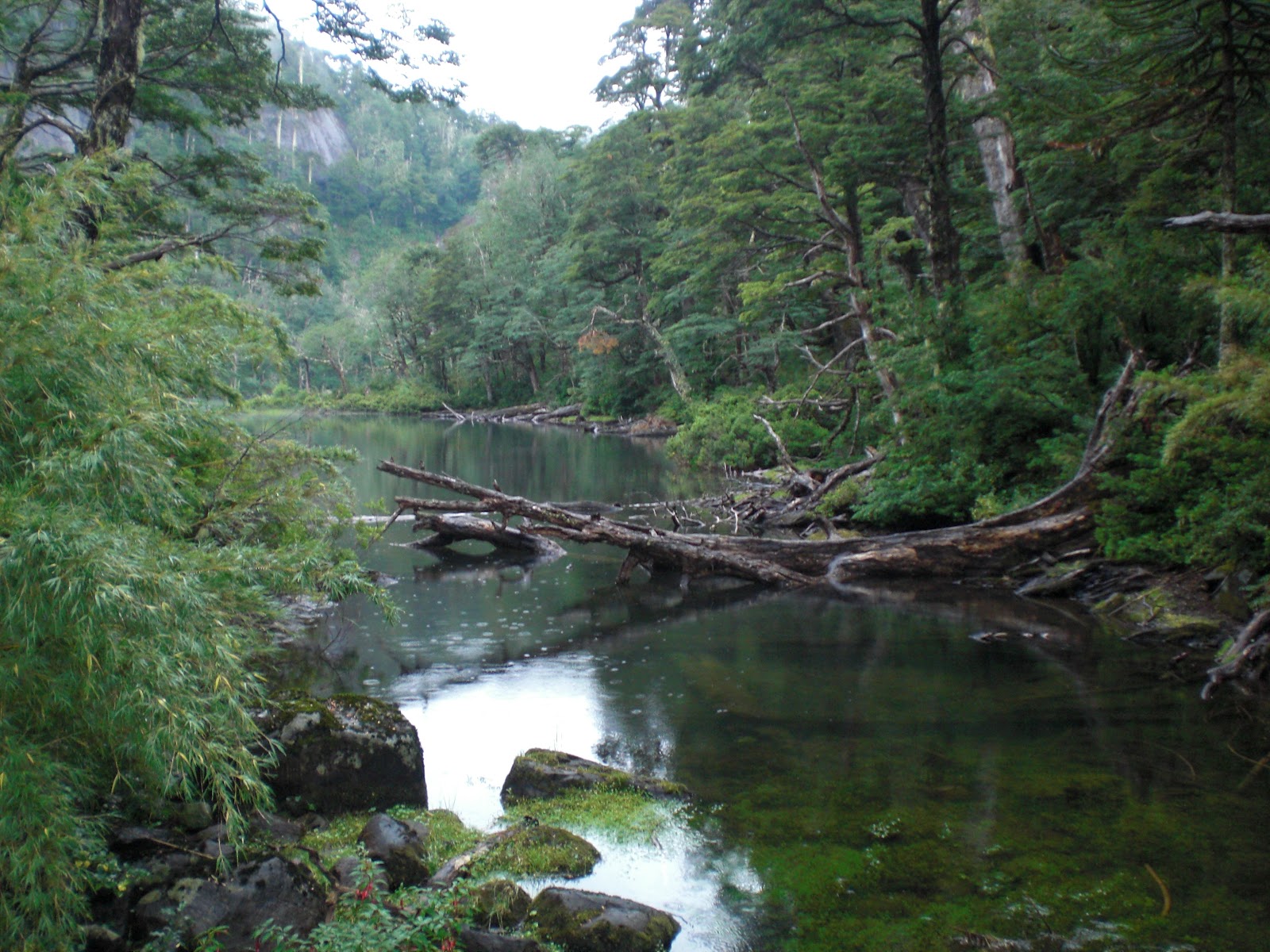
Huerquehue


Day 55 - 29th January
After two active days, and with more showers forecast we spent a relaxing morning hanging around the hostel deciding what to do that wouldn't involve climbing anything.  Eventually we settled on the hot springs, along with a Dutch girl and an Austrian guy.  The hostel runs a tour in the evening but for half the price we took a bus to the springs ourselves.  It was a nice, tranquil way to spend a rainy afternoon luxuriating in hot water, and made a nice change from the activity of the previous days.


Day 56 - 30th January
We had booked a canyoning trip for today, along with a Dutch couple we met at the hostel so we were up early only to discover that it had been cancelled due to the bad weather.  So we went back to bed with tea and biscuits, and later arranged to stay in Pucon an extra day so we could do the canyoning tomorrow.  Then at 1:30 we were told the trip was back on and starting at 2:00.  It's apparently usually very popular, with groups of up to 20, but we were the only 4 people foolish enough to go out in the rain with the river so swollen.  Even our guide, Nicholas said he had never been in such high water!  We spent a fabulous three hours hiking through dense forest, through and across rivers with incredibly strong currents and abseiled down three waterfalls.  The most beautiful part was walking through a deep, narrow canyon, carved by lava floes from the volcano. At points the water was so deep and strong we had to straddle the walls to make progress, and once I lost my footing and was completely submerged in the river.  We were incredibly lucky to have the canyon to ourselves and, having never done it before, I am now a complete canyoning convert!
Me abseiling down the 2nd waterfall


Jon after the first waterfall
 

Walking through the canyon
We survived!


Day 57 - 31st January
We moved back into the friendly comfort of Hostal el Refugio this morning to discover that Franz, a German there, was waiting to cook us breakfast.  He provided fried eggs, tomatoes and mushrooms and we provided the bread and tea.  With everyone else climbing the volcano today (having booked it days in advance in anticipation of the end of the rain), and having failed to do any admin since arriving on account of the incredibly sociable hostel, we spent the day blogging, planning and drinking tea.  We even finally made it out into Pucon for a wander around the town and down to the lake.  With the sun finally out again it was a lovely stroll and the volcano was visible again towering above the town.
Pucon with Lago Vilarrica and Volcan Vilarrica


Day 58 - 1st February
Today we sadly bade farewell to what felt like our home, with lots of hugs for the staff and other guests on El Refugio in Pucon.  We got on a 6 hour bus to the town of Puerto Varas, a German settlement on the shore of yet another spectacular lake, this one under the snowy gaze of Volcan Osorno.  We had originally planned to stay here for 3 nights to take advantage of the lake and nearby national parks but, having been delayed in Pucon, we'll have to explore its sights tomorrow.  Another day, another hostel - this one (Casa Azul) is German-run and the cleanest, most organised hostel we've stayed in so far, with notes  detailing the house rules pinned all over the place.  Puerto Varas itself is a lovely town, bigger than Pucon and set up with more hotels and shops, rather than the refugios, campsites and cabanas we had just come from. 
Lago Llanquihue at Puerto Varas


Day 59 - 2nd February
We enjoyed a great breakfast at Casa Azul and then got on a local bus to take us the hour or so to Parque Nacional Vicente Perez Rosales, Chile's first national park and supposedly one of the most spectacular in the Lakes District.  On the bus we bumped into one of the girls we went biking in with Pucon and discovered that she is booked on the same ferry as us for the next part of our trip!  We decided to spend the day together wandering in the park.  First stop was the spectacular Saltos de Petrohue, a huge series of thundering waterfalls, carved in the lava floes from Volcan Osorno.  Having seen a fair few waterfalls now I would still say this set are my favourite.  The sheer scale and force of them is breathtaking, especially as they sit below the beautiful snow-capped volcano.  We then reached the tiny port of Petrohue, on the shore of Lago Todo los Santos, in the national park - the most beautiful lake I've seen here.  It's waters are stunningly blue and it is ringed all around with sheer, tree-covered mountains, with the jagged, rocky or ice-covered peaks of three volcanoes behind them.  From here it is possible to get a ferry across the lake and cross over the mountains into Argentina.  After struggling to find the hiking trail we wanted (the Chileans don't seem big on signs or maps) we found a track in the woods and followed it, along dried up lava rivers, under the watchful gaze of the volcano.  After an hour or so it started to climb steeply and we managed to work out that we had found the trail that takes you up the side of the volcano, not the easy lakeside stroll we had signed up for!  So, being wimps, we turned back and spent a lovely hour or so relaxing at the lake side.  The lake was so inviting that Jon and I went swimming in our underwear, having forgotten to pack swimming costumes.  The water was cool and refreshing and the scenery so incredible that we were reluctant to get out.  
Saltos de Petruohue and Volcan Osorno
Another great lunch spot
Laguna Todo Los Santos


Having a swim


This was another fantastic day in a truly beautiful region of the country, but tomorrow we must bid a sad farewell to the Lakes District.  Don't worry though, the next chapter will be even more amazing... Tomorrow we head to Puerto Montt to board the 4-day Navimag Ferry to Puerto Natales in Southern Patagonia.  The ferry will take us through the Pataonian Fjords, past glaciers and deposit us close to the Torres del Paine, what a journey!

Thursday, 26 January 2012

Bienvenidos a Chile - Atacama, Santiago and Vino

Day 46 - Day 49 - 20th January -23rd January
Having cleared Chilean immigration we set about finding a hostel in the desert town of San Pedro de Atacama.  As the name suggests, San Pedro is an oasis town in the Atacama desert.  It is a gringo hangout, with more western backpackers than we saw in the whole of Peru and Bolivia put together.  Most of the buildings are made of mud, as it seldom rains in the driest place on Earth!  The streets bustle with backpackers and are full of shops, restaurants and outside bars filled with fire pits at night.  The adobe church in the centre of town was built in the 17th century, its walls are made of mud and the roof is made of wood, both survive to this day.  The change in altitude and temperature was quite something - suddenly we were basking in glorious sunshine, although the nights did get a little chilly, this being the desert.  Our hostel was a very chilled out affair, with rooms arranged around communal gardens strewn with chairs and hammocks, and a kitchen for cooking.  We decided to spend a few days relaxing here, rather than trying to hot-foot it to the beach, as the combination of buses required to do that and end up in Santiago became quite complicated and pricey.  Having spent the last few days travelling through the desert we also decided not to bother hauling ourselves out on any tours of the nearby dunes.  Instead we spent three lovely days sleeping late, wandering the streets, perusing the markets and shops and generally relaxing.  As the cost of everything in Chile is quite a lot higher than Bolivia and Peru it was great to be able to cook for ourselves.  We enjoyed making our own breakfasts and even cooked ourselves a slap-up pasta meal - the luxuries of travelling!


Adobe church, San Pedro
San Pedro streets
Day 49 - 23rd January
Our longest bus journey so far - we caught the 8:11am bus to nearby Calama, where we had a picnic breakfast at the bus station to wait for the 12:00 to Santiago.  The bus to Santiago was 24 hours long, but it was actually not that bad.  We had paid extra for cama seats, that are wider and fold back further, and the bus played a succession of passable films from midday til midnight to keep the weary traveller entertained.  A small dose of Diazepam, procured in Bolivia, helped the night pass soundly, and we woke up in Santiago in the late morning of the 24th.


Day 50 - 24th January
After arriving in Santiago at around 11:00, we walked to our hostel and relaxed in the sunny garden until our room was ready.  After a reviving snooze we set out to explore the centre of the city.  Santiago is a beautiful city, with wide boulevards, plenty of green spaces, grand colonial buildings and modern architecture.  It feels a little like a European capital but on a grand scale, or like a US city with character.  We wandered past some of the government buildings and went into the cathedral (large and very tasteful for a Catholic cathedral!)  After that we rested for a while in Parque Santa Luis, the city's most central park.  There we climbed to the top of Cerro Santa Luis for beautiful views of the city.  Enjoying the green spaces and cafe culture of central Santiago, we decided to head down to the river, expecting to find more of the same.  The only problem is, the Rio Mapocho has dried to all but a muddy stream and the only roads that run along it are major thoroughfares!  Oh well, back to our laid back hostel for a gourmet dinner o f soup and bread, topped off with some local beer.  


Old Congress Building

Santiago


Santiago Cathedral

View from Cerro Santa Lucia


Day 51 - 25th January
Happy day!  Today we went wine tasting in the Maipo Valley.  We decided to forgo the mass production of Concha y Toro, the most popular winery, in favour of some smaller local producers.  One of the best things about Santiago is how easy it is to get to the vineyards.  Less than an hour from the centre of town on the metro we found ourselves at Vina Cousino Macul, a vineyard founded in 1856 by a French family, who still own the vineyard today, as well as another one in nearby Buin.  The tour at Cousino Macul was good value and very informative.  We learnt all about the wine production process, from the methods used in the early days of the vineyard to the latest in modern technology.  The tour also included 2 tastings - a blush white wine, which was refreshing and dry, and a Cabernet Sauvignon Reserva, which we'll look out for at home.
Next stop, about half an hour walk away, was the tiny vineyard of Aquitania.  Set up in the 1990s by 3 French vintners, one from Chateau Margaux and one from Bollinger, with a Chilean partner, they aspired to create Chilean wines of distinction.  Production at the vineyard is very small, producing only 7 varieties, with some of their grapes grown at their other vineyard in the lake district.  We opted for the premium tour here, which included a personal guide around the estate and buildings.  They were bottling some of the wine when we visited, a process that only happens 5 or 6 times a year.  The cellar was very small in comparison to Cousino Macul, and all the bottling, labelling and storing is done by hand on site.  The tasting included a delicious Pinot Noir, their signature Cabernet Sauvignon and a fantastic Chardonnay, voted Chile's best Chardonnay several years running.


Wine tasting at Aquitania

After such a lovely afternoon it was a shame to head back into the city, and the rubbish directions provided by the Lonely Planet made it even more arduous.  We ended up getting a bus in the wrong direction and having to walk over an hour to the nearest metro station!  


Day 52 - 26th January
Today we relaxed in Santiago again, we went to some of the local markets and walked up to the city's tallest hill, Cerro San Cristobal, hoping to go to the swimming pools at the top, but the cable car had now closed and by the time we got there it was too late to walk the 4km up the hill to the pools so we gave up and went back to the hostel.  We had a slight (major!) panic when we discovered Jon had misplaced our bus ticket for this evening.  After searching fruitlessly through our bags we managed to locate the dumpster (excuse the Americanism but we don't have an equivalent word) on the corner for the street where the hostel put their rubbish.  Luckily I always carry some latex gloves and Jon spent an uncomfortable 10 minutes searching through the rubbish before locating our precious tickets!  Cue another laid back evening drinking beer and eating pasta in the garden before boarding the night bus to Pucon in the Lake District.

Wednesday, 25 January 2012

Mines, Salt Flats and Moonscapes

Day 42 - 16th January
Today we got a bus to Potosi, which, at 4090m is the world's highest city (another UNESCO site).  Potosi sits beneath the Cerro Rico mountian, a rich source of silver and was founded by the Spanish as a mining town.  In colonial times it was one of the richest cities in South America and was the site of Spain's colonial mint.  The silver mine is still working, under a cooperative system, whereby each member is entitled to work his own section of the mine and the minerals are sold through the cooperative.  Although there is not much silver left, the mine is rich in other minerals and is very busy.  Working conditions are tough, although now much better than in colonial times when miners would spend up to 6 months living underground, working long days powered by coca leaves.  Millions of miners died in the colonial era.  Today the mine has electric light but most of the work is still done by hand, including setting dynamite, carving the rock and hauling tons of material to the surface by hand.  We took a very interesting tour of the mine in the afternoon, complete with full miners gear.  The mine was quiet as there had been a wedding the day before and most men were sleeping off hangovers, still our guide took us deep inside the mine to see some men at work.  It was hot, dusty, wet and smelly, and the work seems unimaginably hard.  We met one miner, Jorge, who was 15 years old and had already been working for 2 years.  The trip was fascinating, and not nearly as scary as the Lonely Planet makes out! 

Tio Jorge, the Devil-God


Happy miners
Jorge makes dynamite
On the trip we met an American called Ben, who was planning on heading to Uyuni the next day, the same as us, so we decided to team up and travel together for a few days.  After getting out of the mine we relaxed over beers and some local food.


Day 43 - 17th January
Today we took the bus to Uyuni, gateway to the salt flats.  The bus took 6 hours and we arrived mid-afternoon.  There isn't much to recommend Uyuni town as a place to visit - it is thoroughly in the middle of nowhere, strewn with rubbish and has a deserted wild-west town feel to it.  We did, however, find our cheapest accommodation of the trip so far - £3.50 each for a 3-bed dorm.  After trawling the tourist agencies in town we finally booked a 3-day trip of the nearby salt flats (the reason for going to Uyuni) for the bargain price of £68 each.  As far as we could tell, all the tours do the same thing and go to the same places, staying in the same hostels, so there seemed to be no sense in paying twice as much.


Day 44 - 18th January
After the world's most disorganised breakfast we started our 3-day salt flat tour.  There were 6 of us in our jeep, Jon, Ben and me, a Kiwi called Steve, a German called Nils and an Argentinian called Rudolfo, not to mention our driver-cum-guide Javier.  As Ben spoke reasonable Spanish we had decided not to pay the extra 600 Pesos for an English guide, especially as there isn't really too much guiding involved in looking at spectacular landscapes.  That turned out to be an excellent decision as Javier did, indeed, do much more driving than guiding and the sites mostly spoke for themselves.  We met a group who had paid 1200 Pesos for a 'premium' trip with an English guide and they ended up doing exactly the same as us, including the same basic lodgings and food.


Our first stop was the small town of Colchani, where the salt collected from the Salar is processed. We didn't actually see any of the processing, it was really a tourist tat market, although there was a salt museum that was built of salt bricks and housed large salt sculptures, including an armadillo and a giant llama.
Salt llama
After that we visited the salt flats (Salar de Uyuni), which cover an area of over 12000 sq km, nearly twice the size of Lake Titicaca.  This has to be one of the most unusual and spectacular landscapes on the planet.  The white salt stretches as far as the eye can see, obscuring the horizon until you feel like the land goes on forever.  In the wet season the salt is covered with a shallow layer of water, perfectly reflecting the blue, cloud-studded sky in places.  Further in towards the centre, the water dries up leaving just the salt, which is blindingly white.  We took the obligatory silly photos, taking advantage of the lack of perspective in the landscape and spent a good amount of time wandering around and marvelling at the strange wonder of the place.  It is impossible to describe what it looks and feels like, and photos could never do it justice - everyone will just have to visit the Salar to see for themselves!


Jumping for joy in the Salar

Obligatory silly photo

The endless Salar reflecting she sky
After a picnic lunch sitting outside a hotel constructed entirely of salt, we drove on to every boy's dream - a 'cemetery' of rusting trains!  We had plenty of time to play around on the trains, climbing into boiler rooms and funnels, re-enacting film chases running along the tops of carriages. Some had been turned into playground equipment, with swings and see-saws made out of train parts - it was a lot of fun!


Jon plays engine driver


Train cemetery


We then began a long journey in the jeep to our first night's accommodation.  The roads were made of dirt and sand, with steep ditches on either side and the dust from other vehicles and glare from the sun made it nearly impossible for Javier to see the road.  At one point we had a very near miss when the jeep left the road, plunged into the road-side ditch and felt like it nearly rolled over.  We were all thrown from our comfortable seats but Javier did a fantastic job of keeping the jeep upright and we eventually came to a gentle stop at the side of the road with only a few bruises between us!  After that it was easy driving to our first hospedaje (basic hostel) in the small town of Alota.  We had a dorm room for all 6 of us with the creakiest beds in the world, but dinner was tasty and there was a shop selling beer so a good time was had by all.


Day 45 - 19th January
We got up at quite a civilised hour for breakfast and then set off again in the jeep.  Our first stop was a huge boulder field in the shadow of snow-capped volcanoes.  It was quite a sight - boulders big and small as far as the eye could see, and we wasted a happy hour or so scrambling and climbing amongst them.


Boulder field

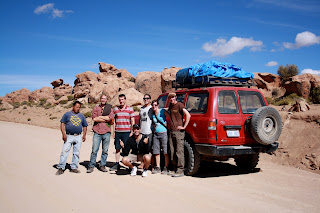
Grupo Javier with our trusty jeep
We spent the rest of the morning driving through spectacular desert lakes.  I hadn't expected the Bolivian scenery to be so spectacular but with each turn of the road we were transported to amazing landscape after amazing landscape.  Sometimes we were in sandy desert, other times boulder fields or mountain lakes filled with pink flamingos, and at times we appeared to have left the Earth far behind as the landscape resembled the moon or Mars.  Our last stop was at the Laguna Colorado, a lake turned bright red by microorganisms - amazing!


Where we stopped for lunch

Laguna Colorado


Tonight we stayed at our highest hospedaje yet - 4900m.  Again we had a large shared room but the beds were comfy and, again, the food was good.  We also celebrated the last night of the trip with a few bottles of Bolivian wine - not the greatest, but needs must!


Day 46 - 20th January
Today we were up brutally early, at 4am, to head out into the desert to see the sunrise over the geysers.  Having never seen a geyser before I was very excited, and this was a whole field of bubbling pools and shooting plumes of steam.  This being Bolivia there were no safety precautions and we were able to walk among the geysers, standing right on the edge (apparently they lost a Japanese tourist a few years ago!)  The desert was freezing at that time of the morning but being amongst the steam helped take the edge off.


Geysers
After the geysers it was time to warm up, so we headed to some thermal pools for a pre-breakfast dip in the early dawn - magical.  After a hearty breakfast we travelled to the last stop on our trip - Laguna Verde, close to the Chilean border.  Apparently the lake is only green when the wind blows, which fortunately it wasn't when we were there.  After spending some time marvelling at the spectacular scenery of southwest Bolivia we bid goodbye to our fellow travellers (who were heading back to Uyuni) and crossed the border into Chile.  Exiting Bolivia was as easy as entering - a few minutes and a stamp in your passport - but when we got to San Pedro de Atacama to enter Chile it was a different story.  We spent nearly two hours waiting in a queue in the baking sun before getting to the immigration desk.  Once there it was a very quick stamp, so I'm not quite sure how it took them so long!  Now safely in Chile we found a lovely hostel and set about planning the next stage of our journey.


Thermal pools
Laguna Verde

Bolivian desert

Sunday, 22 January 2012

La Paz to Sucre

Day 36 - 10th January
Time to say goodbye to the beautiful Lake Titicaca, as we boarded a bus to the Bolivian capital, La Paz.  In typical Bolivian style, our "tourist" bus was not exactly 5* and they had overbooked, which meant Jon had to squeeze in to a tiny seat on the back row and I sat up front with the driver!  The strangest part came when we were all ordered off the bus to board a small boat to cross a section of the lake (our bus went on a boat of its own!)
Bus to La Paz
Countryside on the way to La Paz


We arrived in the late afternoon and checked into our hostel, the Adventure Brew, which is linked to a local microbrewery and gives you a free beer every night - happy days!  We spent the evening chilling in the bar and chatting to an American called Jeffrey, who was 20 months into his 2 year round-the-world trip and had plenty of tips and stories to tell.


Day 37 - 11th January
We spent today exploring La Paz.  It's safe to say it won't make my top 10, mostly due to the huge amount of litter in the streets and the overwhelming smell of urine.  That said, it did have some charm, with small, steep cobbled streets and warren-like markets.  The Witches Hat Market sells the usual tourist stuff alongside teas, herbs and dries llama foetuses, which the Bolivians bury under their houses for good luck.  In the usual small world of travelling we bumped into a couple that Jon did the Inca trail with, who happened to be staying at our hostel, and spent a nice evening in the bar with them.


Dried llama foetuses

Government buildings, La Paz


Day 38 - 12th January
Happy birthday Jon!  Today we celebrated Jon's 30th birthday by mountain-biking down the "World's Most Dangerous Road" - a 40 mile stretch of winding gravel and dirt road that hugs the side of a steep valley with drops of over 600m at the edge.  The route starts at 4700m and descends 3600m to the valley below.  Most of the road is single-track and very narrow in places, meaning that accidents were very common until a new, wider road opened in 2006.  Now the vast majority of traffic down the road is groups of cyclists out for a thrill.  We resisted the huge pressure to go with Gravity, the company owned by our hostel, who charge nearly twice as much as everyone else and, after some research, chose a company called Velocity.  There were 5 people in our group - a Russian man, a Danish couple and us - assisted by Simon, our guide and Manuel, our driver.  We were kitted out in full protective gear at the start of the ride, something I was very grateful of later!


The start of the ride
 The start of the ride followed a tarmac road through a wide valley, with beautiful views of the road and river below.  We then hopped back in our van to drive a short way uphill to the start of the Death Road section.  The top of the road was cloud forest and visibility wasn't great for the first few minutes, until we descended below the clouds and the valley began to open out below us.  The terrain was very steep and rough, with lots of loose stones and gravel - I have to say I hated every minute of this section but at least Jon was enjoying himself.  


Our group on the Death Road

Precarious drops
In the middle section the road levelled out a bit and became smoother, the views were spectacular, I was beginning to trust myself and my bike and was beginning to enjoy the ride.  Obviously that's when I fell off!  True to form it was a comical accident - I got stung by a bee during one of the steeper descents, lost concentration for a fraction of a second and went flying head over handlebars, skidding along the road as I landed.  After laying dazed for a few seconds I brushed myself off and surveyed the damage - the bike was fine, my shorts were ripped, I had cuts and bruises on my legs and hands, a bruised jaw and my elbow was very sore.  As I said earlier, if it wasn't for the elbow and knee pads and the full face helmet, my injuries would have been a lot worse.  Manuel the driver caught up with me, checked I was ok to carry on and radioed the others to let them know what had happened.  Having just started to enjoy myself I was buggered if I was going to give up because of a little fall, so I got back on the bike and worked my way, slowly, to the end of the route with Manuel following behind.  The pain in my elbow as I passed over each bump in the (very bumpy) road was excruciating, but nothing compared to the exhilaration of finishing the ride with my fellow bikers.  We celebrated with beer, followed by lunch and a swim at a nearby hotel.  I don't think me and mountain-biking are destined to be friends but I feel very proud at having completed the challenge, and Jon had an awesome birthday experience so it all turned out good in the end.


Tonight the bar had 2 for 1 cocktails so we toasted Jon's 30th with another friendly group of travellers.


Day 39 - 13th January
After a reasonably late and boozy night we had a well-deserved lie in.  We spent another day wandering round La Paz, skyped our parents so they could say a belated happy birthday to Jon, and boarded a night bus to Sucre.  After the luxury of the Peruvian buses our expectations were high, and the journey started well when we discovered that the bus had seats that lie completely flat.  Our joy was short-lived as, an hour or so into the journey, we found that the bus didn't have a toilet, and the journey to Sucre was 12 hours long!  Fortunately nature called for the driver and we stopped by the side of the road, where we were able to take advantage of the back of a shipping container as a makeshift bathroom.  At least the seats were comfortable as we settled into the rest of the journey.


Day 40 - 14th January
We arrived in Sucre in the early morning and walked for about an hour before we found a hostel.  Having not slept at all on the bus, I went to bed for a few hours while Jon explored the city and arranged to meet up with some friends that evening for happy hour.  Sucre is regarded as Bolivia's constitutional capital and is quite pretty, with a colonial centre filled with white buildings and green plazas.  At 2700m it was nice to be a bit lower again and the weather was noticeably warmer and sunnier.  At 5:00 we met Grace and Dan and their 2 American friends for happy hour - the problem was it turned out to be happy hour on desserts, not drinks - not quite what we had in mind!  Still we made the most of it by sharing nachos and each having a dessert, before heading to another bar with a real happy hour, where we drank 2 for 1 cocktails (the local grape spirit, sangani, tastes a little like gin)


Plaza de Armas, Sucre

Sucre


Day 41 - 15th January
Being a Sunday, everything in Sucre was shut, so we had a lie-in followed by a leisurely day wandering round the city and reading our books.  We booked a morning bus to our next destination, Potosi.